Ancient Akrotiri Santorini: Visitor Guide to the Bronze Age City
Of all the sights on the island, Akrotiri in Santorini is the one that surprises visitors most. Behind a plain entrance in the south west of the island lies a whole prehistoric town, with streets, squares, drains and multi storey houses, frozen at the moment its people abandoned it before the volcano erupted around 3,600 years ago. Magic South is based in the village of Akrotiri, so this is our home ground. Here is everything you need to plan a visit, and if you want someone else to handle the driving, our Santorini Exclusive tour starts right here.
What Akrotiri is famous for
Akrotiri was a thriving harbour town of the Aegean Bronze Age, closely connected to Minoan Crete. Its people traded across the eastern Mediterranean, built houses of stone and timber two and three storeys high, and decorated their walls with some of the finest frescoes of the ancient world.
Around 1600 BC, earthquakes warned of what was to come, and the inhabitants seem to have left in time: excavators have found almost no human remains and very few valuables. Then the volcano erupted in one of the largest eruptions of the last ten thousand years, burying the town under metres of pumice and ash. That ash preserved the buildings, furniture and even beds, which is why Akrotiri is often compared to Pompeii, though it is more than 1,500 years older.
Systematic excavations began in 1967 under the archaeologist Spyridon Marinatos, who died on the site in 1974 and is buried there. Only a part of the town has been uncovered so far, and research continues.
What you will see on the site
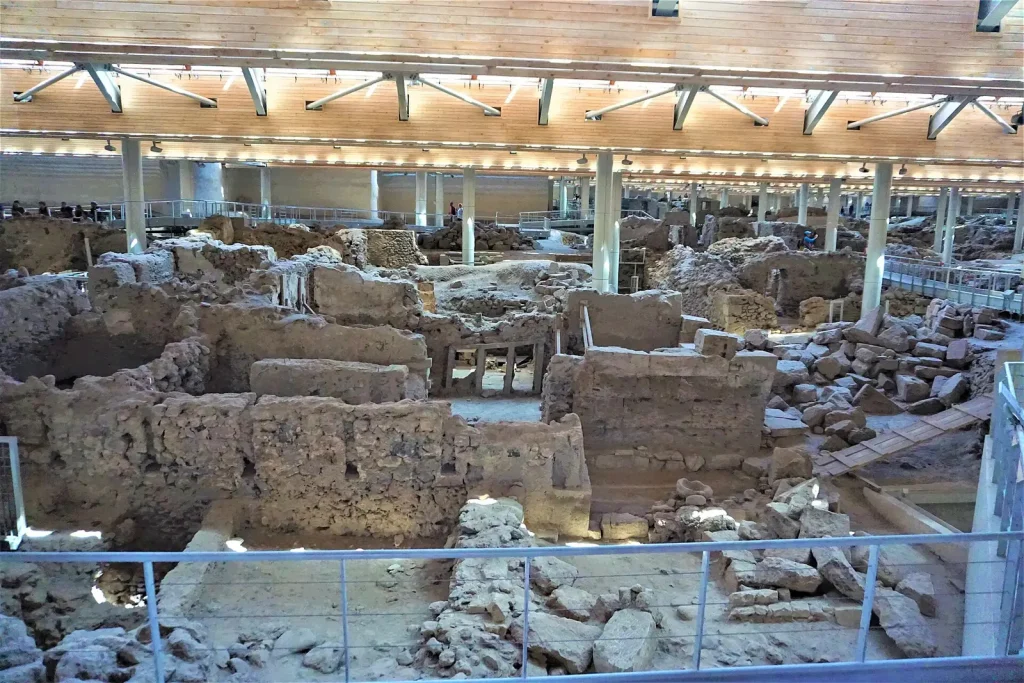
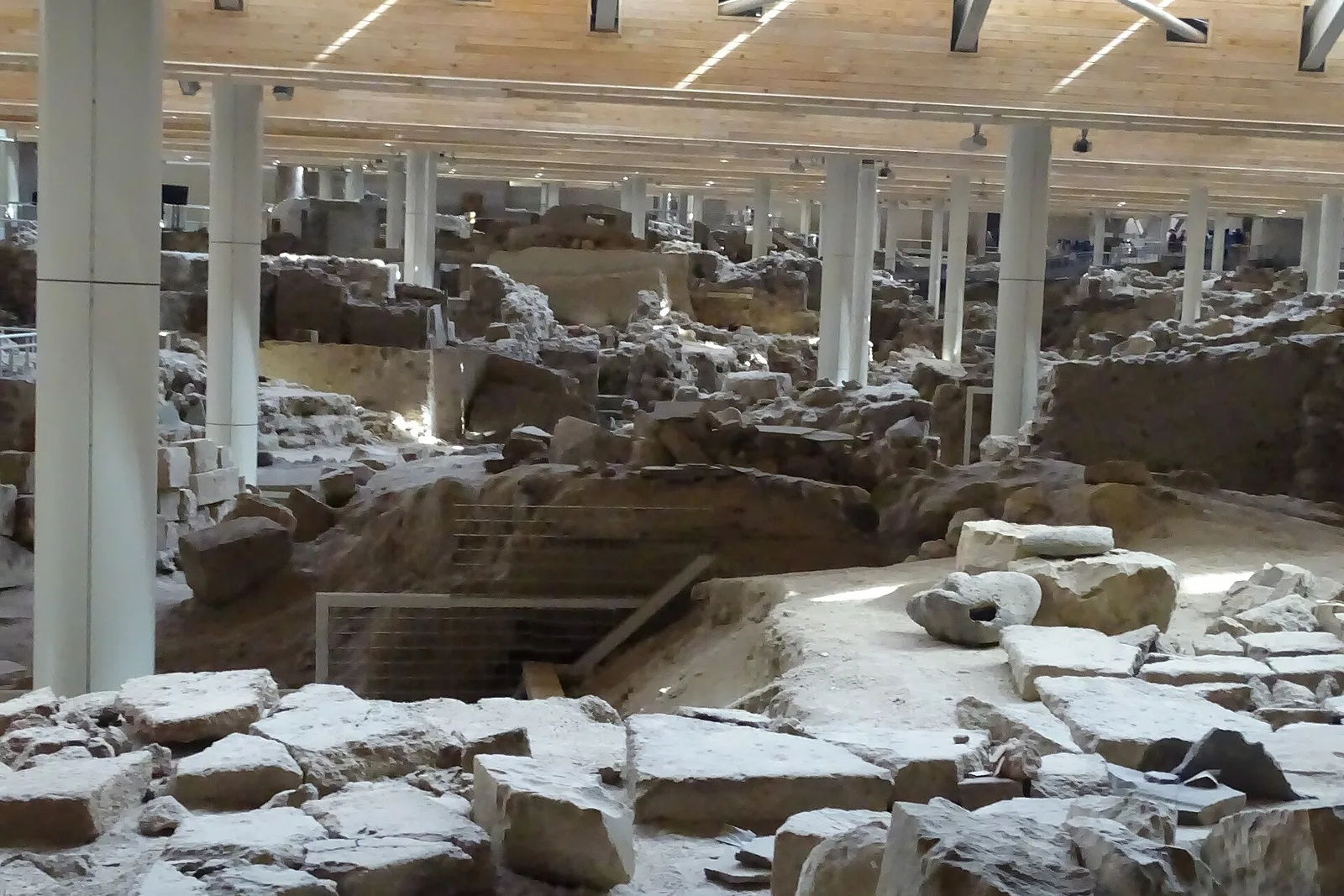
The excavated area is protected by a large bioclimatic roof, and visitors follow a raised walkway above the ancient streets. From it you look down into houses whose upper floors still stand, staircases, storerooms full of large clay jars, millstones and the stone drainage channels that ran under the streets.
The famous wall paintings, such as the Spring fresco with its swallows and lilies, the boxing boys and the fisherman, are not on the site. The originals are displayed in the Museum of Prehistoric Thera in Fira and in the National Archaeological Museum in Athens. If you have time, visit the museum in Fira after the site, the two together tell the full story.
Tickets, opening hours and how long to spend
A full ticket costs 20 euros and a reduced ticket 10 euros, with free entry for certain groups such as children and EU students, under the rules of the Greek Ministry of Culture. Tickets are sold at the entrance and online through the official ticketing service.
Opening hours are longer in summer and shorter in winter, and the site closes on some public holidays, so check the current hours before you set out. Last admission is usually 20 minutes before closing.
Most visitors spend 60 to 90 minutes inside. The roof provides shade, but it can still be warm in summer, so bring water. A licensed guide, available at the entrance or booked in advance, makes a real difference, because the ruins mean much more when someone explains what each building was used for.
How to get to Akrotiri
The archaeological site is in the south west of the island, just outside the modern village of Akrotiri.
| From | By car | By bus |
|---|---|---|
| Fira | About 25 minutes | Direct buses from Fira, around 30 minutes |
| Oia | About 45 minutes | Change in Fira |
| Kamari or Perissa | About 25 minutes | Usually change in Fira |
| Athinios port | About 15 minutes | Limited |
| Red Beach | 5 minutes | Same bus line |
There is a car park at the site, but in summer it fills up in the middle of the day. A private transfer drops you at the entrance and picks you up when you are ready; see our transfers to Akrotiri, with fixed prices per vehicle from 35 euros for up to 3 passengers. For all the ways to move around the island, read our guide to getting around Santorini.
What to see nearby
The south west corner of Santorini deserves more than a quick visit to the ruins.
- Red Beach, five minutes away, is famous for its red volcanic cliffs. Enjoy it from the viewpoint, as access to the beach is often restricted because of rockfall. Our guide to the best beaches in Santorini covers the whole coast.
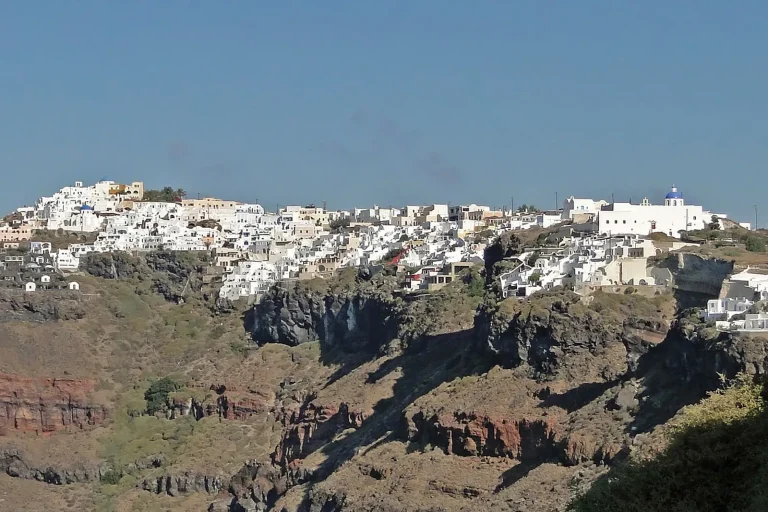
- The village of Akrotiri has a restored Venetian tower, narrow lanes and views over the caldera.
- Akrotiri lighthouse, at the tip of the peninsula, is one of the quietest places on the island to watch the sunset. More spots are in our Santorini sunset guide.
- The wineries around Megalochori are 15 minutes away. See our Santorini wine tour guide.
Visiting Akrotiri on a tour
Several of our private tours include Akrotiri. The Santorini Exclusive begins at the archaeological site and continues to Red Beach, the black sand beach, Prophet Elias and a winery, for groups of up to 18 guests on request. If you prefer the island highlights with a wine tasting, the Highlights Tour runs for 4 hours from 200 euros per vehicle. All tours are private, with pick up from your hotel, and can be adapted to include time at the site.
Featured photo: Joyofmuseums, CC BY-SA 4.0, via Wikimedia Commons
Frequently asked questions about Akrotiri
Is Akrotiri in Santorini worth visiting?
Yes. It is the most important archaeological site on the island and one of the best preserved prehistoric towns in Europe, with houses still standing to two and three storeys. Even visitors who are not history lovers are usually impressed. It takes only 60 to 90 minutes and combines easily with Red Beach nearby.
What is Akrotiri famous for?
Akrotiri is famous as a Bronze Age town preserved under volcanic ash after the great eruption of Santorini around 1600 BC. It is known for its multi storey houses, advanced drainage system and superb wall paintings, and it is often called the Pompeii of the Aegean, although it is far older than Pompeii.
How far is Akrotiri from Fira?
The archaeological site of Akrotiri is about 15 kilometres from Fira, roughly 25 minutes by car in normal traffic. Direct buses run from the central bus station in Fira and take around 30 minutes. From Athinios port it is only about 15 minutes by car, and Red Beach is five minutes further on.
How long to spend at Akrotiri?
Plan 60 to 90 minutes for the site itself, a little more with a guide. Add 30 minutes for the Red Beach viewpoint next door, and if you have half a day, continue to Akrotiri village and the lighthouse, or finish with a tasting at one of the wineries around Megalochori.
Can I take a tour of Akrotiri, Santorini?
Yes. Licensed guides offer tours of the site at the entrance and by prior booking, and many private island tours include Akrotiri. Magic South's Santorini Exclusive starts at the archaeological site and continues to Red Beach, a black sand beach, Prophet Elias and a winery, with pick up from your hotel.
How much does an entrance ticket to Akrotiri cost?
A full ticket to the archaeological site of Akrotiri costs 20 euros, and a reduced ticket costs 10 euros. Free admission applies to certain groups under Greek Ministry of Culture rules, such as children and EU students. Tickets are available at the entrance or online through the official ticketing service.
How do you pronounce Akrotiri?
Akrotiri is pronounced ah kro TEE ree, with the stress on the third syllable. The name means cape or headland in Greek, describing the peninsula at the south west tip of Santorini where the village, the lighthouse and the archaeological site are located.